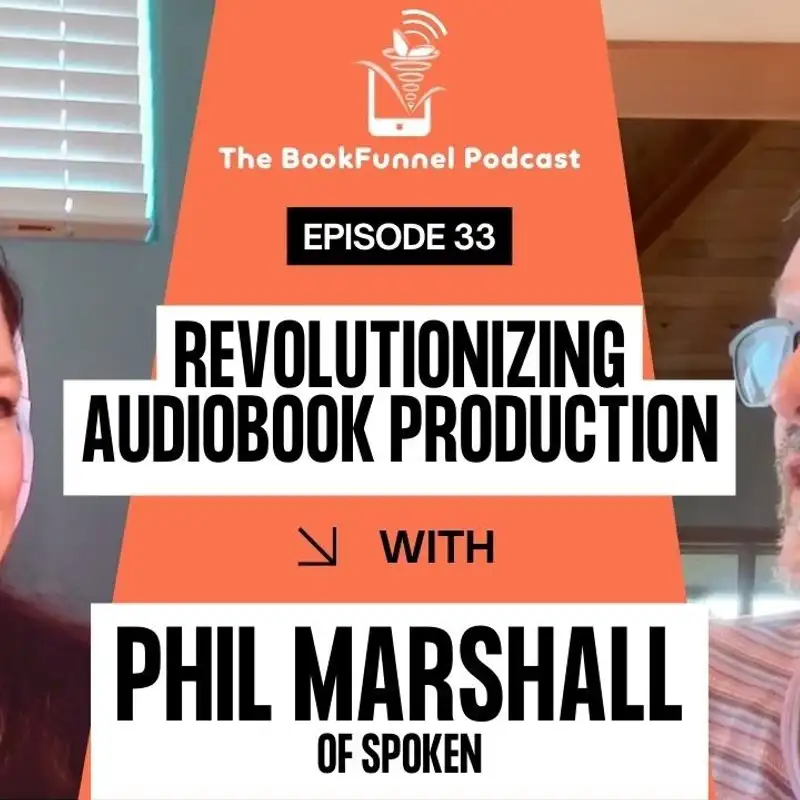
The Future of Digital Audiobook Narration with Phil Marshall of Spoken, The BookFunnel Podcast Ep 33
0:00: Like, I've heard AI slop.
0:01: I've heard virtual voice on, on Amazon.
0:04: I can't really take it.
0:05: I immediately turn it off, right?
0:06: That's all, that's all the sentiment generally that's pervasive right now.
0:10: But you'll be able to listen to this and you'll be like, I had no idea.
0:13: I had no idea.
0:14: It was a way that, that it's not only would you not need to know whether it's AI narration or not, but, but you're really brought deeply into the story because of how vivid those characters are and their.
0:25: Interaction, their banter, their cadence together.
0:27: And so that's what we've, that's what we've created.
0:29: It's Spoken.
0:30: Hey, folks, welcome to the Book Funnel podcast, where indie authors get real-world advice on writing, publishing, and growing a career on their own terms.
0:39: Whether you're just starting out or you're deep into your author journey, we're here to help you build your readership, boost your book sales, and connect with your audience.
0:46: Each episode, we aim to bring you insights from authors, experts, and industry.
0:50: Insiders who have been there, done that, and then some.
0:54: My name is Jack.
0:55: I am our lead author support specialist here at Book Funnel.
0:58: And I am joined today by my co-hosts, Kelly Tanzy and Emma Allison, our guest for this episode of the Book Funnel podcast, a debut techno thriller and hard sci-fi author and founder of Spoken, Phil Marshall.
1:13: Phil, guys, good to have you.
1:16: Good to have you here on the podcast.
1:18: Of course, we had the chance to connect a little bit at Author Nation, but for the folks who aren't familiar with Spoken and with yourself, with Phil Marshall, fill us in.
1:29: what are you're all about?
1:30: What's spoken all about?
1:31: Yeah, sure.
1:32: So, the Spon came out of my own journey as an author actually.
1:36: So I've been a technologist for many years and conversational AI and healthcare and, and, we sold my last company and then I went to go finish my my novel Taming the Perilous Skies and in that journey, the bug bit again.
1:50: I I'm an audio, I'm only reader myself.
1:53: And, and so that's how I consume stories.
1:56: Story.
1:57: And so when I started to learn about the emerging technology that could allow authors to not just more inexpensively bring their story to audio, which has been historically a very expensive endeavor, but my personal passion is with great vivid multi-voice, a full cast, multi-voice audio, and I knew.
2:18: , that there were a lot of challenges there, but I also knew what those challenges were.
2:23: I, I had a good handle on those, and, and I found it spoken to be able to bring that capability to authors, bring vivid duet narration, multi-voice, single, or, or, dual narration to life, not just inexpensively, but vividly, like in a way that, that it's not only would you not.
2:42: Need to know whether it's AI narration or not, but, but you're really brought deeply into story because of how vivid those characters are and their interaction, their banter, their cadence together, and so that's what we've, that's what we've created, it's spoken, yeah, yeah, and I know for.
2:58: A lot of authors, because this is, this is kind of a thing over the last several years here that has been emerging and for the longest time, getting your book in audio, it's been kind of, I don't know, it's one of those things that hasn't been accessible to everybody.
3:13: And this is something that we've we've talked about in a variety of, we've talked about it on webinars, we've talked about it on the podcast.
3:19: And this digital narration is, is one of those potential solutions for folks who, you know, it's, it's just not in the budget to hire a narrator, you know, there, especially if you are an indie who's new to the scene, you're, you're a, a new author.
3:37: Yeah, you, unless you have the money set aside and the, the money to burn, potentially, cause you don't know if you're gonna get a return on that audiobook narration.
3:45: Right, that's, that's, that's a hurdle for a lot of folks.
3:49: So I'm personally glad to see that there are options like spoken out there.
3:54: And, and I think for a lot of folks, it's, it's gonna be, it's gonna give them the opportunity to get their books and audio that they haven't, they wouldn't have had otherwise.
4:02: So, so I, I really do appreciate that.
4:04: It's interesting your backstory, and, and it totally makes sense, by the way, that you're working in technology and now, now the pieces connect and And so how did that kind of, or maybe go into a little bit more detail about that, how that kind of informed the, the creation of the, of the platform and, and all that.
4:23: Yeah, so, I'll give you the exact moment.
4:26: So it was July 2023 and I was at Tao's toolbox, one of the great workshops in.
4:32: Of fiction under Nancy Cress and Walter John Williams.
4:34: There were 18 of us there for two weeks at the writing workshop, and I met some people there that have just become like lifelong friends.
4:41: One of them was an AI technologist and another funniest guy I've ever met, the lead writer for the game Hell Divers 2.
4:50: Russ Nichol, and he inspired me to write the story to submit for the second week critique, and I did it in 24 hours in the weekend between week one and week two.
4:59: It was called Kill Your Darlings, and this little story.
5:02: , is an elderly Norwegian woman.
5:05: It has a Russian man and his daughter.
5:07: It has a gay couple from America, and then it has this English writer, except we learned later that he's actually from Bakersfield, California, and the whole British accent was, was a put on.
5:17: His entire, his entire life's been a put on.
5:19: And so this mystery unfolds, and with Russ's inspiration to kill your POV character in the first scene.
5:25: I, I rotate through and I killed every POV character that the writer was writing about, his other five people in the chalet where they're all stuck there together in a storm.
5:33: And so, and so I knew that that was going to make for a great audio, you know, multi-voice audio.
5:40: I just inherently, it's just kind of what the way I think.
5:43: I think in accents and I think in in sounds and banter and cadence, and that's just how I think.
5:49: And so I went to go create that story.
5:52: I tried AI and then the accents were there, so I had to hire a couple of voice actors.
5:56: That was 1000 bucks right there, boom, 1000 bucks.
5:59: And so I'm like, oh my God, you know, the workflow of the tools, the expense of, you know, voice actors, and then the mixing when you're doing, when you're doing multi-voice, what we call multi-voice or full cast, you know, I think you probably get this, but maybe some of your viewers haven't really thought about it like this, and that is that every one of those dialogue tags is in the narrator point of view and the passage spoken aloud by the character is in their voice, right?
6:24: And so you can imagine the mixing that you have to do, you know, slicing the dialogue tag from, and so I did that, I actually did that.
6:31: I did that in Camtasia is what I use, but like Final Cut Pro, you, you have to use one of these, one of these, editing tools, and I'm like, oh my God, the, the cost, the time, the pain, and, and so out of Tao's toolbox in that story, Kill Your Darlings came.
6:46: Came spoken and every, every release we have I put Kill Your Darlings back through spoken and my goal, of course, is that manuscript in great vivid multi-voice out and as little work in between as possible, right?
7:04: snap the finger and out it comes and, and we're getting closer and closer.
7:08: We're actually, we're about probably 3 weeks away from.
7:12: , a massive change in how people will be able to do multi-voice.
7:18: And, and I know that, you know, this is, you know, a podcast that, that, you know, gets edited and so there's a little bit of time between now and, and when it goes live.
7:26: So, by the time this, this goes live, we may be live with what we call NV2 or or multi-voice too.
7:32: And, and this, it's a very exciting change because it'll just.
7:36: Get us that much closer to manuscript in vivid multi-voice out and allow your readers to be lost in story in a way that they've never been able to before.
7:45: This for us is not about just making it cheap and accessible.
7:48: Yeah, that's the economic argument, and with full cast it easily cost you $20,000 or more to go with full cast, you know, using traditional studio recordings now, yeah, but now whether it's single narrator or it's, it's multi-voice, it's all the same price.
8:03: It's a fixed price.
8:05: And so it makes it very accessible, but also good.
8:09: I mean, you know, it's, it's got to also be great.
8:11: So my own book is, is coming out in audio in late February or 1st of March, and 100 speaking characters, each voice designed around that character and for that character and exclusive to me as the author, and so that's going to be a bellwether moment, I think for people to say, I didn't know.
8:31: Like I've heard AI slop, I've heard virtual voice on, on.
8:35: Amazon, I can't really take it.
8:37: I immediately turn it off, right?
8:38: That's all, that's all the sentiment generally that's pervasive right now.
8:41: But you'll be able to listen to this and you'll be like, I had no idea.
8:44: I had no idea it was that good.
8:47: Right, right.
8:47: No, that, that's exciting.
8:48: And I, I know I played around with 11 labs a while back, and 11 labs is great and I know you guys use some of their voices even I, I, I believe if I'm not mistaken, or their voices, some of those voices are available.
9:02: We, we use two narration providers.
9:04: We use 11 labs and we use Hume, and, and they come with different pros and cons.
9:10: but we're, we're the ones that are putting that, that scaffolding around that mechanism for getting the right cadence and inflection.
9:17: It's that scaffolding that I think is so helpful because I've had the chance to, to upload a few short stories spoken.
9:24: When I worked directly with 11 labs, it's, it's not exactly, and granted, it's been a while to give them, you know, to be fair to them, since I've played with it, but it's not built for authors in that sense.
9:36: And that scaffolding is, like you said, it's kind of missing.
9:39: And so, So it was just gonna be a lot of work, more work than it was honestly worth to put together a full cast, you know, multi-voice audiobook, digitally narrated that way.
9:51: But I, I, I'll tell you, and, you know, I go into whenever I'm, I'm testing out, you know, a product in the industry, which I get the opportunity to do sometimes.
10:00: You know, I go in and, and I, I don't have any bias.
10:03: I put my books in there and it came out and yes, you're right, there's, there's a little bit of tweaking here and there that I, I've had to do, but otherwise it's great.
10:12: And so I've been very impressed with the platform myself because it's, it's solved that problem.
10:17: I'm actually one of the people who's like, man, I really wish that somebody came along and did this and fixed that problem, and you are, you're fixing that problem.
10:24: I'm trying to fix that problem for you.
10:25: Yes, so I, so I appreciate it.
10:28: I, I, I know that I do.
10:29: So that, that's, but that scaffolding is, is really, I think, what is gonna make, what, what makes it so much easier to use.
10:36: So for anybody who has tried to do it themselves with 11 labs or what have you before.
10:41: Yeah, you know, this is a different experience is what I know.
10:45: Well, we, we only focus on one audience.
10:47: We're, we're by storytellers for storytellers to bring your story to life through great audio, and, and so that's why the workflow is designed around that because that's all we focus on.
10:56: And, and, and so yeah, I appreciate you saying that.
10:59: That's, that's exactly what we were, we were after, yeah, yeah.
11:03: Good deal.
11:03: I think Emma and Kelly, you each had a question.
11:05: I'm gonna tee you up here.
11:06: Emma, do you wanna go ahead with yours?
11:08: Cut.
11:09: Say Mandarin.
11:10: No, I need you to say Mandarin.
11:11: OK, Mandarin.
11:12: Say it again.
11:14: Mandarin.
11:14: OK, I just wanted to make sure my, because the video is lagging to the audio.
11:18: I wanted to make sure my audio is not like 15 seconds behind.
11:22: No, you're good, I think.
11:23: OK, you just said, OK, so it's not.
11:24: OK, good.
11:25: All right, I did say cut, so, all right.
11:28: Yes, go ahead whenever you're ready, resume, resume.
11:31: OK, so whenever a tool like this comes out, I'm really interested in how I can incorporate it into like my current production process and I did throw in a novella into spoken to kind of see, see what that whole multi-voice thing was.
11:44: I was actually really happy with what came out.
11:46: But how does it work as far as the credit systems and all of that?
11:50: Because like with 11 labs, if you keep reiterating your chapter, I ain't got that kind of cash, bro.
11:56: But with spoken, could I be in theory, writing my book?
12:00: And if I want to throw a chapter in there and How it sounds as part of like my writing or editing process.
12:06: Am I able to do that, or am I making sense?
12:09: You, you are making sense, yeah.
12:11: So a couple of things about that.
12:12: And so we have designed the, the business model and the financial model around authors and how they work.
12:19: And so it's, it's free to use a when perfect.
12:22: That's our, that's our tagline for our pricing model.
12:24: And what that means is you're not nickel to none.
12:27: For how many different iterations of these re-narrations you do.
12:31: We don't care.
12:32: What matters is your word count, period.
12:35: And so, you pay a fixed amount per finished words.
12:39: And so, the street price is $20 per 5000 word block, or if you're a subscriber, or it's 50% off of that.
12:48: So, so it's $10 per 5000 word block.
12:51: So, that is a fixed price per finished word.
12:54: That's very different than the other models.
12:57: As far as using spoken for just proofing your work, you, you absolutely, absolutely can, but that's not really, you can do that, you can do that in so many different places.
13:09: If you work in Google Docs, Google Docs can, can just read back, back to you in a way that doesn't require any, any change at all.
13:17: And, and so that's certainly you can do that in spoken, but we're, we're designed around really creating that perfect end result, the one that actually goes to your readers, right, right.
13:26: I know I myself, I have you have an update in your book.
13:30: Word count matters and so let's say the You add another 5000 words, you would then pay when you're publishing that, right?
13:37: Only at the time that you're ready and it's done and you're ready to publish, would you then add that amount of cost to the project.
13:43: Yeah, and I, I like the idea that you, I can do this in small chunks too.
13:48: I have a Patreon account where I upload chapters.
13:53: Yep, on a weekly basis, and so I'm looking at it to do the audio versions of those chapters too, and being able to do it in like 5000 word chunks makes that's the flexibility that that that I would, yeah, I think serialization is just gonna grow more and more and more, and we're, we're doing, a lot of work on YouTube now, so serializing.
14:14: , as basically episodes or installments, your chapters, as part of a, playlist that's becoming more and more a central part of what we, what we output to on, unspoken.
14:27: So yeah, realizing, yeah, we, we started out back, back what seems like 1000 years ago now, and you had to do it all in one, you had to publish all in one lump sum.
14:36: , but now we changed that a while back, and that is, that is, you can just selectively, you know, publish your, your stuff as you're ready to go.
14:44: We'll only charge you on the stuff that you end up publishing, right.
14:49: And so yeah, yeah, pretty flexible.
14:51: I think that's great.
14:52: OK, so I'm the one who hasn't had a chance to, to play with it yet.
14:56: But so I just had a question about identifying characters and all of that.
15:00: What is the process of like picking your characters' voices, because that can be, you know, even hiring a human narrator, it's like, how do I get the right voice, right?
15:11: So how do you, well, how does that work with spoken?
15:15: In fact, I'll tell you a little story.
15:17: So, because Audible right now requires human narration, you know, they're the only, they're the only holdout, right?
15:23: Spotify for authors allows, allows digital narration everywhere else, pretty much allows digital narration, but Audible is still human narration.
15:30: And so for my own Taming the Perilous Skies, I'm finishing right now, I'm finishing the duet narrated audiobook, Ryan Haugen and Rebecca Broke all sands, and, and so it's gonna be great, it's gonna be awesome.
15:40: But when it came to 100 speaking characters and, and interacting with those two and saying, you know, what should these characters sound like, I'd already done it unspoken, so I knew exactly what these characters would sound like.
15:54: So the spreadsheet of all the characters with their, you know, their, their accent, I had the sound clips there of every single character and How I had it in my head.
16:04: And, and so that was a, that was an interesting exercise.
16:07: Now my, my voice actors don't have any question about what I'm after.
16:10: But how do we arrive at that?
16:12: That is, that is a big part of the secret sauce, man.
16:15: When, when you put your story through spoken, and then you open up every one of those characters, after we do the full analysis, you'll be able to see the description.
16:25: And the voice prompt that results in either the custom voice or which of the voice actor voices in the library best fits and what you're what you're looking for and what's needed there, but that analysis of the character itself actually is built up over multiple chapters, and then the prompt that describes the voice, the, the, the timbre of the voice, the cadence of the voice, the pitch, all of those attributes to the voice.
16:50: We, we draw from that characterization, and then that's what loops through the custom voice generation and that's what results in, you can do as many samples as you want, pick the one that you like best, change the prompt if you think it's a little bit off, whatever, make it what you want, but that's how we go about doing that and you can automate all that at the beginning of spoken when you upload your full manuscript, you can say, do you want us to generate a custom voice for every character, and we'll give you the, the top choice that we think.
17:18: You can always go back and change it.
17:19: You can always sample a lot more and change anyone you want.
17:22: And more and more folks are like, Yeah, I'd do that.
17:24: And Hume voices are fantastic.
17:27: We're going to be going to be moving with Hume into a new version of their tech, which is going to be even better.
17:32: And so for my Taming the Perilous Skies, I, I use Hume voices.
17:36: I use 11 labs for some things, but, but I use Hume for most all of it.
17:41: And that comes out with just a great natural emotive end result, but the actual timbre, the actual quality of the voice itself, it's a big part of our secret sauce on how we come about that.
17:51: I had a question there about that because that's interesting.
17:54: Now, I have a lot of characters in my books who do what I call code switching.
17:58: So in one scenario, they'll be like really fancy polished French.
18:02: A and then in another situation, they'll be like Jenny from the block.
18:05: Now, can the prompt account for that?
18:08: Like how the characters themselves will sound different based on not just emotion, but like situation and things like that.
18:14: Yeah, yes, yes, you know, you, you'll still be able to tell it's the character, but you can pass for any given passage.
18:20: You can pass in emotional cues and then, and.
18:23: And basically change the prompt for certain sections.
18:26: the French accent is a perfect example.
18:28: and so yeah, you can pass that stuff in for various blocks to, to basically change it up.
18:33: I've got one character in Kill Your Drawings, I mentioned this earlier, it feigns a British accent up front.
18:39: But then later it's the same character, but he's from Bakersfield.
18:42: He's got just a, you know, nondescript American accent.
18:46: And so I love, I love that stuff.
18:48: I didn't realize in writing that story that that was going to be the perfect test story for an audio an AI audiobook company, and, there, there you have it.
18:56: I got lucky on that one, right, right.
18:58: No, it's, it's pretty flexible when I look forward to testing acts.
19:02: Yeah, you'll like it, you'll.
19:06: Yeah, and, and the, I know from playing with it myself, it does do a pretty good job of identifying all of the characters and, I found there weren't very many voices that I had to switch up myself, so cool, yeah, that's great.
19:20: I was, I was pleased with that.
19:21: And then the ability, that's the adding emotion and so forth, that's one thing that I haven't played with yet, but I imagine like as these tools just get better because you, you mentioned, you know, Hume, their voices going, they're updating to a new version as this technology improves, I imagine this whole thing is just gonna get.
19:40: Easier to produce, right?
19:41: There's gonna be problems or problems that might exist now that aren't going to exist in the future.
19:46: It's just gonna improve over time.
19:48: I what's the, what's kind of the, the horizon that you're looking at is kind of what I want to know for, for where, where this is, this is going to.
19:56: What's in the future?
19:57: You know, it's funny, back more than a year ago, Richard, your colleague, he interviewed me for, a class that he, that he has, and, And somebody in the class was like, what does 5 years look look like?
20:11: And I said, Let me tell you what I wasn't able to do 6 months ago, but I can do now, right?
20:17: And I talked about the custom voice around every character, and I said, I couldn't do that 6 months ago.
20:23: I can do that now.
20:24: For you to ask me what 5 years from now looks like, flying cars, I mean.
20:30: We're moving so quickly, but my, my job, my, our, our job is, is very focused on taking your words and producing a great vivid output in audio that that readers can just get lost in story, right?
20:45: Because audio is, is such an important and central part of our lives now and growing like gangbusters.
20:52: And so, and so, as far as the big hurdles that exist right now, that We are going to be able to overcome our pronunciation consistency.
21:01: That's one thing.
21:03: adherence to lexicon, ven Labs adheres to lexicon nicely.
21:07: So we have lexicon up front where you can specify your phonetic pronunciation of something so that we're always sliding that in as the way that should be said.
21:16: But, but Hume doesn't adhere well to that.
21:19: And so, that's going to get better.
21:21: And the thing that we're going to be really turning on its head is how do Achieve that cohesion between multiple speakers, the cadence, the timing, the emotional cues, the inflections.
21:31: I'm not talking about stuff you hear on Notebook LM like the, theos and the laughs and the blah.
21:37: I mean, yeah, those, that, that's fine.
21:39: And, and, and do I think we'll do more and more of that?
21:42: I do.
21:43: It's not a big demand right now in the audiobook industry to have that kind of thing or sound effects or anything like that.
21:49: It's really about the delivery of the lines with the.
21:51: Reflections that you need, a little bit of laugh here and there, you know, is needed.
21:56: And so all that stuff is coming along nicely from the tech standpoint.
21:59: But that narrative cohesion is something we're going to be really turning on its head here very soon and making it, making it even better.
22:07: And so I'm excited about that.
22:09: I'm really excited about that.
22:11: Yeah, the, the, the lexicon is a must-have for anybody who's like, I'm a sci-fi author, so I make up words all the time, right.
22:20: You have to have that, or you spell a character's name funny, and like to the reader, it's obvious what it should be, but yeah, don't you, exactly, that's that's one thing that has been that was helpful for me.
22:30: I I use that quite a bit, but it's exciting to see where that's that's gonna.
22:35: Yeah.
22:36: I wanna, for, for the folks watching who maybe they haven't worked, you know, they haven't touched digital narration before, this is something, I don't know anybody who's not aware of it.
22:47: I'm pretty sure everybody out there is aware of it at this point, unless somebody's, you know, living in a cave, perhaps, but, but then how are you here watching the Book Funnel podcast?
22:55: I guess that's the question.
22:56: Anyway, but You know, they haven't worked with digital narration before.
23:00: There's some questions I know some folks have around like, OK, well, like, these voices that you're using, right?
23:07: Do these, do these belong to like real people and how are they, like, what is the, the provenance of these voices and that sort of thing?
23:15: I know some people have concerns with that.
23:17: So, if you can, you can speak to To those potential concerns that yeah, yeah, yeah, and especially if you're online, you're on Reddit, you know, and you're, you're going to see, yeah, mostly a lot of just flaming on, on AI narration, on digital narration, but I think, I think that some of that is well founded in that it was initially a cheap option but not a good option.
23:41: Mhm.
23:42: And now it's becoming not only a good option, but the best option because of, again, some of those things we talked about, the voice quality being so tuned to that character, right?
23:53: And, and the mixing of it and the, and the balance and the and the intonations and the, the narrative cohesion that that is achievable now.
24:02: But still, you know, even in a year from now, you know, after plenty of good examples are gonna be out there, like Tammy the Perilous Gus, I would say is going to be.
24:09: A bellwether moment on people be like, oh, I had no idea.
24:12: OK, and that's my goal with, with putting that out.
24:15: But on Spoken, if you want to read about how these voices and the narration itself are the models are actually created.
24:24: We have, a page called Ethical AI on Spoken.
24:28: Press, and, and it's all right there.
24:30: You can read all about it.
24:31: 11 Labs and Hume on the narrative side, and then we use LLMs on the.
24:37: You know, on the scaffolding, on the analysis, the character analysis, and all that, and you can read all about that.
24:43: We have agreements with our partners to not utilize what we put through their platform in the generation of their models.
24:52: The stories that your authors put through spoken are not going to be used to further those models.
24:57: That's by.
24:58: Agreement.
24:58: It's like a legal agreement that that we have with all of our partners.
25:02: But when it comes to the narration themselves, are these stolen voices actually going from the grapheme, which is the actual, you know, combination of characters or letters, into what that sounds like and the differences that that might sound like by accent or what have you, going from grapheme to phoneme.
25:19: Is is something that is primed through public domain content very easily and then also with the work that 11 Labs and Hume have done on paying the folks to contribute to those models with full consent.
25:32: And, and they also do a job in making sure that known voices, that a likeness that people are already aware of or familiar with, that, that people can't go and upload recordings of.
25:44: You know, Dr.
25:45: Emmett Brown, and then generate the Doctor Emmett Brown or Christopher Lloyd voice because they, they actually detect that and look for that.
25:54: Anyway, ethically it's very important to us.
25:56: It's important because we know our author's concerned about it.
25:58: We're concerned about it.
26:00: We are very, very focused on that.
26:02: So yeah, that page I think will be helpful to your, to your, yeah, yeah, yeah, no, that that's, that's good.
26:07: That's good, because I know there will be inevitably some questions about that.
26:10: So that's.
26:11: That's good to know.
26:12: That's good to know.
26:13: OK, now, I really love my human narrator, but I'm also a businesswoman, so I'm kind of looking for a happy medium.
26:19: Could I maybe contract my narrator?
26:23: To somehow clone her voice and only I use it on spoken, or how would that work?
26:28: Because my thing is I love the technology, but like I really emotionally want some type of human other than the coders, yay the coders to get paid.
26:37: That's a purely emotional thing though.
26:39: Yeah, yeah, no, that's a, that's a great point.
26:40: In fact, the, the whole library of voices unspoken is voice actor voices, so the three options are.
26:46: Your personal voice, you can record your personal voice.
26:49: You can use a custom generated voice.
26:51: We talked about that a little bit ago, about how we designed, right?
26:54: That's voice design.
26:55: And then it's, it's the library of voice actors, and so we'll surface which voice actor might be best for a given character, based on how we characterize that.
27:04: As far as you having your narrator, that you like and you want that voice available, it can, they can do that today on, on 11 Labs.
27:13: we can also work with it on Hume.
27:16: And so if an author really wants someone only available to them, we can create the personal voice clone and make it available just to the author.
27:24: The, the difficult part of that is the ethics.
27:27: In your case, no doubt you would have full consent by the voice actor to have done that, but we would want to make sure that that.
27:34: That's pretty well documented because it's, it, you know, if, if, if a voice actor puts their voice on 11 Labs or Hume, they go through that process of like everything's above board and we know that if we do it on your behalf as an author, which we will do, the team is great.
27:49: If you talk to Stacey, I mean, you guys know Stacey.
27:52: And and she'll be happy to, to, support you on that.
27:55: We'll just need to make sure that the voice actor is fully, fully in the know on that.
27:59: That's wonderful cause I think that gives that kind of middle of the road option that allows, cause like with ACX you can do the whole royalty share thing as the more affordable option, but I like that that's available.
28:11: I'm gonna, I'm gonna be in some talks with some people.
28:15: Well, let's talk about it, just a moment more because the topic becomes a little bit more interesting.
28:19: If you, if you talk with voice actors, they, they fall into generally two camps right now.
28:24: One is, I'm OK reusing my voice, but I'd say that's a pretty small minority, using their voice on voice models for other work that they're not.
28:33: Then going to get paid for.
28:34: They're only on 11 labs or that's passive income, there's a mechanism there of payouts, etc.
28:40: But if they're not, and you're just going and you're reusing their voice but not paying them directly for the next story or what have you, you know, there's, there's a, I would say the majority of the voice actor camp is, like I.
28:51: You know, I, I, I'm very proud of my voice.
28:54: I want to do the studio recordings.
28:56: I want to do that for you.
28:57: That's my livelihood.
28:58: And so that becomes a trickier thing, which is why I say for us to go and do that on behalf of an author's behalf, we really need to make sure that the voice actor is good with that too.
29:08: Yeah, that was kind of my thought, like have some type of deal where every book I produce with your voice, you get a grand or something rather than 30.
29:15: One thing they can do is they can go on 11 labs or we can do it via Hume at Spoken.
29:21: And, and then it can be used rather than placing that voice on the marketplace for general consumption, it could be used in a more private fashion, and yet 11 Lives would still be responsible for the payout to that voice actor because that's their mechanism, that's what they do.
29:37: And, and so I think that might be a good option, but, but yeah, you know, it's interesting, this gets into that, that topic of ethics there, and we love voice actors.
29:45: I've got voice actors for my, my book as well, and And in fact, I talked with them like, what would you think if I were to use, you know, use your voice, you know, outside of the work there, and not so much.
29:56: And, and so, yeah, it's just something that we're sensitive to.
29:59: Yeah, yeah, well, and I, I think it's, it's good for folks to know that you do have You do hire voice actors as well.
30:07: This is, this is not meant to replace voice actors.
30:10: And I think there's maybe a misconception that somehow this is, maybe in some cases, there's some competition.
30:16: I'm sure that this, this is a disruptive technology to some extent.
30:20: But there's a lot of authors who are gonna be creating digitally narrated audiobooks that otherwise, they just wouldn't have had an audiobook, right?
30:28: It's not as if they, you know, if they couldn't afford to pay a human narrator, right?
30:33: Instead of, and instead they make a a digitally narrated audiobook.
30:37: It's not as if that edit that, that narrator, I don't know if I said editor previously, that narrator, it would have, you know, They didn't have the money to pay them in the first place.
30:47: Yeah, it's kind of you get, you're hitting on a really important point is generally speaking, this is not a zero-sum game.
30:54: This is, this is something that, that wouldn't have been turned into audio.
30:58: This is from the backlist.
30:59: OK, you took your marquee title and you paid your 5000 for your, for your voice, you know, actor narration, and, and.
31:09: And yet your other 50 titles, you know, like, like audio is now a primary, not a secondary, a primary modality of consuming story.
31:18: This is, this is no longer an afterthought.
31:21: It can't be any longer an afterthought.
31:24: And so marquee titles and on Audible, right, you know, the voice actor studio recording is fantastic, and that's the gold standard.
31:32: I will say that from a quality perspective.
31:35: From a vivid multi-voice and engaging perspective that I think fits a little bit more in line with decreasing attention spans, that, that what we're doing is probably a better fit long term for that kind of audience because of just attention spans and things like that.
31:53: From a true emotive delivery standpoint, whether it's single or it's duet.
31:59: Narration voice actors are still the gold standard, and for marquee titles, I think that's great, but you're right, the backlist, that ain't gonna ever see audio under those kinds of prices, right, right.
32:10: And it gives you the ability to, to bring those books to audio when it otherwise wouldn't have been practical, economical, etc.
32:18: That's right.
32:18: Exactly.
32:18: Does the language matter at all?
32:20: Like, I have my German translation, so I can just upload my German translations too, and it'll.
32:25: Yeah, absolutely.
32:25: So whatever voice you choose is generally going to be fluent in 30 languages, OK.
32:32: So, and so I have characters that you didn't realize were fluent in Italian until that scene where they come down like a rapturous nun, and, and, you know, all of a sudden it's, it's Italian.
32:45: And so I've got a lot of scenes like that.
32:46: I, I love that.
32:48: and so yeah, absolutely can do that.
32:49: Here's the, here's the challenge, and we're actually working with some folks to overcome this challenge.
32:53: And that is while you as the author or your producer, we now support, a role called the producer, which gets the dashboard view to be able to support multiple authors, which is, which is a very exciting development.
33:05: So we're, we're now working with a number of folks, author, anchor, and others to actually use our, our producer dashboard where That producer is developing that audiobook unspoken on behalf of several authors, their, their books for several authors.
33:18: The thing about translation is that while the author or their producer can, can proof English really well or their native language really well, proofing your international translations is, is not something that you're able to do directly.
33:33: And so how do you proof the audio in a language you don't speak?
33:38: And so, we're coming up with some solutions on that.
33:42: there's folks like Wordcount who will do it for you.
33:45: Scribe Shadow will do the translation, and then the folks at Word Count will, will actually proof the audio for you, but that becomes a bit of a challenge.
33:53: Right.
33:54: Well, and having multiple people, you could very easily before publishing have give access for somebody, it sounds like to be able to go in and then proof it and say, yep, this sounds good, or there's these passages that should be, should be edited, and then it's otherwise it's ready to go from the sounds of, of it is that you're able to, yeah, yeah, that's right.
34:13: And so this is another rule of that dashboard is that if you've got these, say, 30 passages that need to be reviewed for their accuracy because they're in a non-native language.
34:23: Then that would go into their dashboard.
34:24: They get to review that and, and, and then, you know, you would pay them, you know, either directly or, or through your spoken process.
34:33: So, yeah, that's, that's gonna be a very interesting scenario to, to farm out, you know, your various, you know, aspects for you.
34:42: Well, and we, we see that on Book Funnel to some extent, a feature that we have is team login access.
34:48: So if there's an author who, like, they, you know, they love Book Funnel, they're using Book Funnel, but they have hired somebody to manage all the work that gets done on Book Funnel for them.
34:57: I could see authors even outside of the translation.
35:00: In context where it's like, OK, I'm bought into this, but I don't have the time, even though spoken is going to save me time, right?
35:07: And I, I'm gonna hire somebody to go in and, and do the, these multi-book audiobook narrations, right?
35:15: Look, if it costs you, for your 100,000 word novel, OK, if it costs you a couple 100 bucks to do that total, right, finished cost.
35:24: , unspoken, but you don't want to have to go and, and proof it and review it and all that because that's just not your, your bailiwick, right?
35:32: I mean, I mean, you know, I, I do that for my work because I'm an audio, I, well, I founded the company too, so I guess that's, you know, obviously I have a little bit of a, you know, you know, to be fair, a little bit of a focus there, maniacal focus actually, but, but if, if an author is not that, and most are not, by the way, you know, I mean, we honestly, we, we listen to some of the stuff on, on, unspoken, and we're.
35:54: Or like, sister, you ain't gotta get in there and you gotta, you know, you gotta fix it you know and we'll we'll send notes to authors like, it's like, hey, do you wanna you wanna work with with a producer like from Author Anchor, you know, to go and help you on this.
36:07: I feel you so hard on that.
36:10: Yeah.
36:11: Yeah, right.
36:12: And so if, if you were to pay $200 yourself, would you instead pay $400 where a couple $100 went to that producer to proof it and it, and, and so, oh, you're already, you're already at less than 1/10 of the cost of a normal, you know, studio narration.
36:30: And so I don't know, it's an interesting, you're right, it is disruptive to some extent, but it's also, I think, a total, total value add, you know.
36:39: I mean here at Book Funnel, like we're, we're founded on a disrupt disruptive technology, the ebook, so like that that's not meant to be derisive in any way, right?
36:50: That's the nature of, of, of, you know, economies, they get disrupted.
36:55: That's, that's kind of part of it and we'll sort this whole thing out.
36:58: Yeah, oh, I know.
36:59: Yeah, these, and these things get sorted out over time.
37:02: It, it, it kind of reminds me of like the Napster days, you know, when that was the, the whole thing and Metallica was up in arms about their songs being pirated and there were lawsuits and we sorted that whole thing out and realized, OK, there's rules.
37:17: Well, no, they didn't.
37:18: Well, they got sorted out.
37:19: They got sorted.
37:20: That was part of the, the whole thing.
37:22: I actually know the CTO of, of Napster, and, while that was a very interesting.
37:27: Interesting time and a great thing to have on your resume.
37:30: It did not result in riches to the, no, no, but that problem, I guess was what I'm trying to say.
37:35: That problem got sorted out.
37:37: The problem got sorted out, yeah, exactly.
37:39: And when it comes to AI because AI touches a lot of different things, and so in this case, AI voices, right?
37:45: Yeah, there's, I feel like in the AI.
37:48: Voice category, a lot of those problems have been like the solutions that are being implemented now already, but like, like the, the payout models that, that 11 Labs has and that sort of thing.
38:02: So I, I feel like from the ethical standpoint, you know, everybody who's involved has consented to this sort of situation.
38:09: Right, the people whose voices were used consented to it.
38:12: And so along those lines, I think that, I think that, you know, one of the, one of the other things to, to, to think about, and this is one of the things that even I didn't realize fully until we, we got the company underway, and that is that, you know, I'm a control freak on my story, right?
38:29: I mean, every, every author is a control freak on their story.
38:33: It is art.
38:34: It is their art.
38:35: And, and so it's my workflow.
38:38: and if I learned something from readers in this version and I want to update that EPub on Book Funnel, right, I go and I do that.
38:46: Like I, I knew, like, let me give you an example.
38:49: So, I got a one-star review.
38:51: , a couple of days ago.
38:53: Characters, the concept, the book was good, but then I got to chapter 46, which by the way, is 4 chapters from the end, and, and the president in the year 2076 was, was.
39:04: Being reflective.
39:05: And, and she made a reference back, not in a positive or negative way, just sort of a historical way to present, present day, like, like 2025, you know, politics.
39:14: And this reviewer said, because you brought politics, you know, into it, you know, I realized that you're just a biased person, one star, right?
39:24: And so they said, otherwise.
39:26: Good book, but one star and what I realized is, OK, first of all, you're a dick, so there's, there's that, so you know, screw you, but you know, listen, nobody's book is for everybody, right?
39:35: But really 4 chapters in the end you thought it was a good book and there's half a sentence that, that anyway, don't, OK, so the point is we feel like that, that half a sentence is not important, yeah.
39:48: That's not important.
39:49: And so let's say that you've done your audiobook in the traditional way, and you've got that half sentence, you're like, I'm gonna get rid of that because there's no reason to have it there.
39:57: It's just, you know, it's an unforced air kind of thing, right?
40:01: Well, what do you have to do to, to go, I mean, my God, right?
40:06: So, so think about the workflow of updating.
40:09: Your EPub like that and now being able to just update your audiobook that, right, the workflow control, right?
40:17: I'm, I'm completely under control, you know, and, and I'm the one that oversees this entire endeavor and I can change it like that.
40:25: Workflow becomes massively changed when, you know, with things like this, right?
40:30: And honestly that.
40:32: The lack of that would be a deal breaker because I'm one of those authors who, after the book is published, I will still go back and be making edits because I'm reading it like a reader.
40:41: I love to read.
40:42: And the fact that I can go into spoken and just process those the same way I process my vellum is And your word count's not gonna change, so you're not gonna get charged a dime more, right?
40:54: You've already paid for that many words in your project.
40:58: Done, finished.
40:58: If you have to go and you have to change, you know, 20 passages, 50 passages, you know, 100 times, you're still within the same, you know, general word count.
41:06: You're not gonna pay a dime more.
41:08: Go do it, right?
41:09: Knock yourself out.
41:09: Make the work as good as you can make it.
41:12: Yeah, like a lot of authors are creative perfectionists, and, and so we, we have the tendency to do this.
41:18: It's the George Lucas effect, right?
41:21: Although George Lucas, that's another, that's another topic, really, right?
41:25: But I totally get it.
41:27: I've done that myself.
41:28: I don't know you personally, but no, no, but, well, well, on that, I think the difference is that Star Wars was already a success, well, a huge success, and then he went back and made, oh well, this little thing needs to be tweaked.
41:40: I need to.
41:40: Fix it like George, everybody loves it.
41:42: Just leave it alone.
41:43: Leave it the way it is.
41:44: Whereas, I gotta tell you, if you're on that, Jack, I'm just gonna, gonna riff on that.
41:47: And that is that, that, that I think he did the film a disservice by adding in the CGI stuff that's now in the standard version that you see, right?
41:58: You're there at most isly, and you've got the, you know, the creatures, you know, walking around, and, and I'm like, no, you didn't.
42:06: It didn't add anything.
42:07: It didn't need you.
42:09: need that, you know, and by today's standards, I mean, you know, video, AI video is really, it's animation, it's just the next level animation is animation that's accessible to all of us now, right?
42:21: And so like my cinematic trailer pertaining to the peril of sites, it's stunning.
42:26: I mean, it's just, it's just jaw-droppingly stunning.
42:29: And so to see stuff like that in Star Wars, it wasn't necessary to begin with and now by comparison to current day, it's like, yikes, you know.
42:37: Yeah, no, I've, I've seen a, a fan-made, and it was made with AI.
42:42: It was AI video, but a fan-made short Star Wars, I think it was maybe like 5 or 10 minutes long.
42:48: It looks better, it looks better than the than the most recent Star Wars movies, and with a better plot too, but that's, that's also another, that's another.
42:56: Yeah, well, the recent Star Wars movies, yeah, I mean, you know, The Force Awakens, I thought was a great reboot.
43:01: I mean, I, I just think that, that, that, you know, JJ Abrams did a, did such a nice job there, right?
43:07: It was JJ Abrams.
43:08: That's Abrahams, right?
43:09: He was, yep, for the first one.
43:10: Yeah, yeah, and, and so just brilliant.
43:12: Reboot and then they just lost it.
43:14: They just my God, like, like I'm like, I'm like, OK, you know what, if the Empire can just grow starships out of the sea, then why would they ever have lost, you know, I mean, there's a lot of questions there.
43:28: For sure.
43:29: But, let's do a separate that's a separate podcast that can be the after, after Dark podcast where we talk about Star Wars and everything, right?
43:38: But to bring it, to bring it back again, just talking about AI in general too.
43:44: And you're talking about like your book trailer.
43:46: And I'm sure that there's things like like that where I think where audio also really lends itself well to social media.
43:54: You have a lot of authors jumping on the TikTok sort of thing.
43:57: And I think that using your audiobook, however, you've produced it makes a lot of sense in that regard.
44:04: So making it through, especially when you have the multi-voice aspect that you can get through spoken so easily, you can not just sell that as an audiobook, but you can use it to market your books in that context too.
44:17: Yeah, yeah, in fact, you're gonna see something, I'm not gonna, I'm not gonna tip my hand too much on this, but you're gonna see something called motion.
44:25: From spoken motion.
44:26: And, and so we are going to be helping authors do some pretty phenomenal things when bringing their story to viewers.
44:33: It's, it's, yeah, it's any time.
44:35: OK, so I have a match made in heaven.
44:38: Hear me out.
44:38: Hear me out.
44:39: An author scale spoken integration.
44:42: So when I am creating my, My taglines, my hooks in author scale.
44:49: I can send them over to spoken to be narrated and then send them back to author scale to be uploaded as narration along with the video or something like that.
44:57: But yeah, yeah, so, so that's, that's right.
45:00: Do we need to introduce you all?
45:02: In case you didn't know, Arthur Scale was our last guest that we had on the last episode, so it's very fresh.
45:09: Yeah, I actually, you should, you should do that because we have an API integration and we're doing the API integration for motion as well where technology integration partners can do that on behalf of their author users in a click, you know, it's like bringing your EPub over and turning it into the audiobook, you know, like that, or it's bringing those essential elements over to create that trailer like that.
45:31: And, and so, yeah, absolutely make that, I was thinking about face content too.
45:36: Because Kate Hall, she's the TikTok guru, and she's like, Face content, face content.
45:40: And I'm like, I don't want to do like 12 or 13 takes while I'm videoing, but if I could just like put a manuscript of face content hooks or whatever and have them narrated and in my voice, my cloned voice, and then just overlay that over the video, the face content video, like that's going to solve a production problem.
45:59: You've, you've basically just, just nailed exactly the kinds of things that we're Planning for motion is those kinds of options, right?
46:07: Like how do you want that, that aesthetic.
46:09: So having the, having the author image there is, is a really important element, I think.
46:14: And, and, in fact, right now we have a competition going on called Your Story, and it's a, it's a short work under 10,000 words audio from spoken, of course, but then the author's own story is part of the competition and it's all going to be rated on how much of you.
46:31: Comes through the story.
46:32: Why were you the only one that could have brought this story to life?
46:35: We think that's important.
46:37: We think that's important for every audiobook.
46:40: And so being able to incorporate that in those promotional materials, you know, even your interview, we, we do something right now unspoken that's become really popular.
46:48: I, I, I had a sense it would be, which is why I, I came up with it, but, but that is the ability to, you know, when you, when you have your intro or front matter for, for a spoken audiobook, it says, Aid was spoken in your narrator's voice, the voice that you have in your book, you know, your narrator says Maid was spoken, and then there's a little jingle, and then it says, you know, Tame in the Perilous Skies by Phil Marshall, right, your, your title and author, and then you can add your own personally recorded intro, and, and so that all becomes part of the front matter and more and more people are really adopting that to, to put their little signature, you know, why.
47:25: It was them that brought this story to life.
47:27: And I just love that.
47:28: Yeah, yeah, no, that's, that's, in fact, that's something that book Funnel is, we're exploring something similar to that.
47:35: If you're familiar with our ebook signing feature that we released.
47:38: Yeah, I love, I love that.
47:40: Yeah, we want to do the same thing for audiobooks and give authors the ability to add that little audio clip in there.
47:47: Yeah, in fact, we, we, we've talked with your folks about that.
47:50: We know.
47:50: Exactly how to do that.
47:51: And, and so I think that it'd be a great little touch, right?
47:55: Your version has the personalized thanks to the to the reader and in the author's voice, right?
48:02: Right, right.
48:03: And yeah, we, we know how to do that.
48:05: Exactly.
48:06: Right now, so for somebody who is approaching spoken or maybe approaching digital narration for the first time or whatever the case may be, but approaching spoken for the first time.
48:16: What are some of the, the resources for folks?
48:19: Do you guys have, I know you have a support team.
48:22: Do you have some like a, a Discord community or anything like that for folks?
48:26: Yeah, our Discord, our Discord's active, and, we have Ask Patrick, which is our AI assistant.
48:33: We're, we're constantly feeding all of our new learnings and all the things that come up into it, so it's always, you know, not.
48:39: Knowledgeable of the latest and greatest, which is, which is pretty cool, but then it's also the real Patrick sits behind that.
48:44: So, we, so you'll eventually find him if, if, if the material, you know, doesn't satisfy your needs.
48:51: And so yeah, we're there, we're humans behind all of this, and so, we're not gonna, we're not gonna let you flounder.
48:58: Our goal is the same as yours, and that is bring a great story to life.
49:02: Yeah, excellent, excellent.
49:03: Well, Phil, I wanna thank you for joining us for this episode of the Book Funnel podcast.
49:08: Anything you want to mention here before we wrap up?
49:11: No, I just really appreciate the time.
49:12: Love what Book Funnel's doing as an independent author.
49:15: I'm looking forward to having my audio and all on Book Funnel and some of the new discovery features that you guys have is very exciting.
49:23: We're at the conferences, we're at Author Nation and Reader Nation, so definitely find us there and keep an eye on what we're up to.
49:32: Too, because we're gonna be launching some really exciting things, whether it's just continuing to be a leader in vivid multi-voice or it's things like the motion stuff we talked about.
49:42: So keep a close eye on it.
49:43: It's moving fast and we're, we're gonna be there to help you.
49:46: Excellent, excellent.
49:47: Well, thank you again, Phil, and thank you, of course, to my co-hosts, Emma Allison and Kelly Tanzy.
49:53: I really could not do this without the both of you, so thank you for, for being here with me along for the ride.
50:00: And thank you to you, our viewers.
50:03: If you're watching here on YouTube, make sure you're subscribed to the channel, like this video, and leave a comment about your number one takeaway from it.
50:13: If you're listening to the podcast on Apple Podcasts, Spotify, or elsewhere, please follow us there and leave a review.
50:20: It really does help.
50:21: From everybody here at Book Funnel, I wanna thank you for watching and listening, and we will see you all in the next one.
50:28: Thank you for watching.
50:29: Check out these other videos from Book Funnel.
50:31: And don't forget to subscribe to the channel.