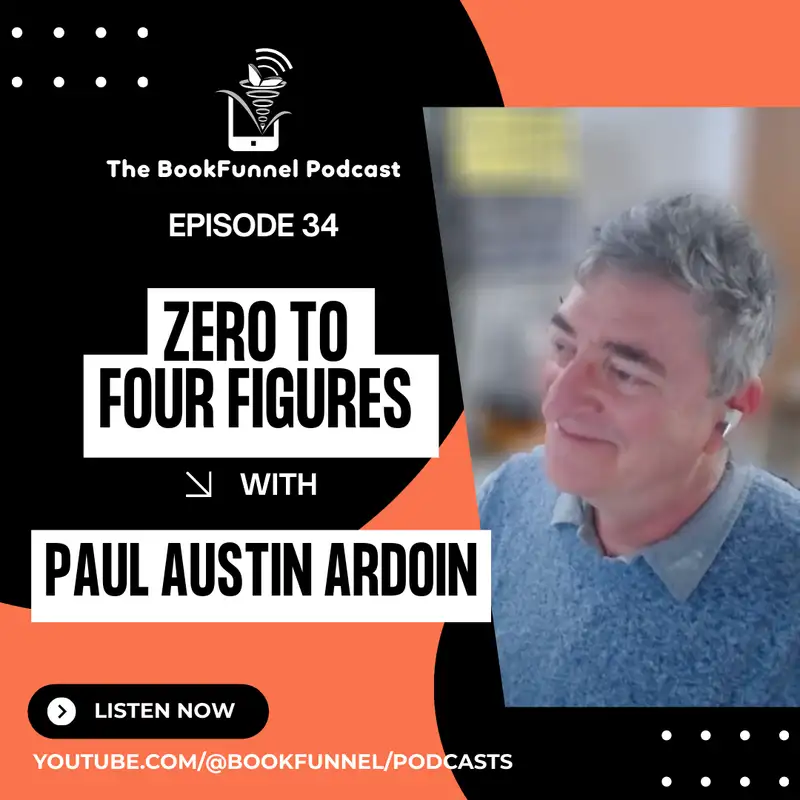
Zero to Four Figures as an Indie Author with Paul Ausin Ardoin, The BookFunnel Podcast Ep 34
0:00: And it feels to me, when, when I hit the magic 1000 number, I think, I think my first month was October 2019 when I finally, finally hit $1000 a month.
0:11: That felt like a, a, a, a big weight lifted off my shoulders.
0:16: I wasn't spending my own money.
0:19: To promote my books and, and I was spending my, my book money to promote my book.
0:25: And I think that, I think that's really important for any author.
0:27: Everybody says you have to crawl before you can walk and you have to walk before you can run, and I think this is teaching, I, I think this is teaching authors how to walk.
0:37: Hey folks.
0:38: Welcome to the Book Funnel podcast where indie authors get real-world advice on writing, publishing, and growing a career on their own terms.
0:46: Whether you're just starting out or you're deep into your author journey, we're here to help you build your readership, boost your book sales, and connect with your audience.
0:54: Each episode, we aim to bring you insights from authors, experts, and industry insiders who have been there, done that, and then some.
1:02: My name is Jack.
1:03: I am our lead.
1:04: Author support specialist here at Book Funnel, and I am joined today as always by my co-hosts Emma Allison and Kelly Tanzy.
1:12: And joining us today, our guest Paul Austin Ardoan, USA Today bestselling author.
1:21: Welcome, Paul.
1:22: Glad to have you here on the podcast.
1:23: Really great to be here, Jack.
1:25: Thanks for having me, Emma Kelly.
1:27: We, we got the chance to meet at Author Nation.
1:30: , here in 2025, just over a month ago.
1:35: For those of us in the audience, who don't know who you are, though, let's start there.
1:42: Who is Paul Austin Ardoin?
1:44: So, I became a, I became a published author about seven years ago, and I had always thought of myself as a novelist since I was 6 years old.
1:57: And then I got into my early 40s and I thought, you know, if I think of myself as a novelist at some point I'm going to have to finish a novel.
2:06: So I, I, with the help of Nano Rhimo, I made myself a promise.
2:11: I said I would finish the novel even if I thought it was terrible.
2:14: I'd started a bunch and abandoned them because I thought they were terrible, but this time I got about 2/3 of the way through.
2:20: I'm like, wow, this is terrible.
2:21: I would Totally abandoned this if I hadn't made myself promise to finish it.
2:25: And then I got to the end of it.
2:26: I'm like, oh, I see what the problems are.
2:28: I can change this.
2:29: I can fix some of the major problems.
2:32: Got an editor and had it launched about 6 months after finishing it, and I thought it was a great experience.
2:39: I wasn't sure if I was going to continue it, but I have.
2:42: And now it's been about 20 novels later, and I've got my main series is the Fenway Stevenson mysteries.
2:49: I've got 11 books and 2 novellas in that series, 11 novels and 2 novellas in that series.
2:54: I've got another series called The Woodhead and Becker Mysteries.
2:58: I just finished the 5th book in that and handed it off to my dev editor, and then I've started a new series called The Time Loop Detective, which is like Groundhog Day but with murder.
3:08: I remember you telling me about this, yeah, yeah.
3:11: Yeah, and I love time loop movies and stories, and it really doesn't matter the genre, and I noticed there weren't, there were a whole bunch of romance and a whole bunch of horror and a whole bunch of action and a whole bunch of comedy and a whole bunch of romantic comedy.
3:24: There weren't a whole lot of murder mystery time loop, maybe the Stuart Tatton, you know, 71 Hal Deaths of Evelyn Hardcastle, but I've had a lot of fun writing it and I've learned a lot along the way.
3:39: I've made a lot of mistakes along the way, but one of the things that I did a couple of years ago is I really, I'd been asked a lot for advice for other self-publishing authors who were just starting out, and I thought, you know, I could just put this into a book.
3:56: I had given a couple of presentations to some Sister Sisters in Crime, remote media.
4:01: over the last couple of years and I decided to put it into a book and help people who were just starting out.
4:08: Right.
4:08: And yeah, and that book, that is 0 to 4 Figures is that's that's the title of that book, right, from 0 to 4 Figures, and it is specifically getting somebody to to make $1000 a month and not revenue, but profit of $1000 a month.
4:30: And I know because for the first couple of years of my journey, it was a real struggle to get people to read, to get people to download, to build my email list.
4:41: Do all those things that that all the book marketing books said, oh, you should totally do this and you'll be ordering your yacht in no time.
4:50: But it wasn't really working for me.
4:52: And so finally it did work for me.
4:54: And that's what I put in the book.
4:56: Yeah, yeah, I know when we met in Vegas at Author Nation, that you mentioned that title, you you, you dropped the title of your book in our conversation.
5:06: And that's when I knew, oh, we have to have you on the podcast, because, which is, by the way, that's going to be part of what we're going to talk about today is some of that.
5:14: I liked it because it's so approachable, right?
5:17: It's not, you know, become a six-figure author or even 5 figures, which would be great.
5:23: I think.
5:24: A lot of authors would, would love that, but like 4 figures is approachable.
5:29: It's achievable.
5:29: I think a lot of authors can see or can more easily visualize the steps that it would take, and what that would do for them and their life.
5:38: And there's maybe some extra, maybe it's more motivating than is the thought.
5:42: Yeah, to get, to get to that point.
5:44: Yeah, I think, you know, low 4 figures every month, you probably won't be able to quit your day job with that.
5:51: But it is, it is something where you're, you're, you're getting more out of it than you're putting into it.
5:57: And it feels to me when, when I hit the magic 1000 number, I think, I think my first month was October 2019 when I finally, finally hit $1000 a month.
6:09: That felt like a big.
6:12: Weight lifted off my shoulders.
6:14: I wasn't spending my own money to promote my books, and I was spending my, my book money to promote my books.
6:22: Yeah, and I think that, I think that's really important for any author.
6:25: Everybody says you have to crawl before you can walk and you have to walk before you can run, and I think this is teaching.
6:31: I think this is teaching.
6:33: Authors how to walk.
6:35: The, the crawling is you get a book done, which 99.9% of people never accomplish.
6:41: You, you put it out there, which is a scary thing to do, and then people don't read it and it feels like, oh no, what, what now, right?
6:51: So, right.
6:53: Right, exactly.
6:54: I think for a lot of folks, that's how that story ends.
6:57: But then there's that kind of weird middle ground, like the dream is that, right, you're gonna release this book, and everybody's gonna love it, and you're gonna have not necessarily overnight success, but the dream is to have, have people read what you wrote and enjoy it.
7:11: And there's, there's a long way to go from releasing your first book to where that's kind of like your day to day experience.
7:19: Where, where you have raving fans and, and all that stuff and, and so I, I like the idea that that we're getting there.
7:26: You mentioned some mistakes that you made that kind of had a hand in this book coming to be.
7:33: And so, not, you know, to make this a faux pas here, but what did you do, Paul?
7:38: I'm curious to know what some of those mistakes were because I think obviously.
7:41: Our audience, I'm, I'm actually curious to know myself what those mistakes were so we can, we can all learn from them, which I think is the idea.
7:49: Yeah, and I've made mistakes at different points in my journey, for sure.
7:54: And you know, one of the things about books that tell you how to do book marketing is that at the beginning, and you actually hear this in with some marketing sessions as well, we're To assume that you wrote a great book, that it's the best it can be, and when authors are just starting out, they don't really think maybe it's the best book that they've they've read, or it's absolutely the thing that they love, that they've spent 8 or 10 years of their life, their blood, sweat, and tears on it, but they don't realize that it might not resonate with.
8:27: with readers and they usually don't know how to make sure that what they've written reaches the audience to whom it will resonate.
8:37: That was one of my biggest issues when I started out.
8:41: I originally, so my, my, my sleuth's name is Fenway Stevenson, and her father was a huge Boston Red Sox fan and named.
8:48: After Fenway Park, the stadium where the Boston Red Sox play their games, and so I had a whole baseball thing.
8:55: I named it, I named it Out of the Park because the dead guy was found just outside of a state park, but it had a whole baseball theme in it, and I had mapped out this whole thing where, I don't know, runners at the corners and all kinds of things, and then I realized, and fortunately I had another self-published author who had who had sort of guided me through the process to go, you know, mystery readers and baseball fans, the Venn diagram might not be as close to a circle as you want that to be.
9:27: And then I started looking at what people were titling their Their stuff when when they put it out.
9:34: So Sue Grafton is one of my, one of my favorite authors, and she has a whole A is for alibi, B is for burglar, the Stephanie Plumb mysteries by Janet Ivanovich, one for the money.
9:47: Every book has a number associated with it.
9:52: So it's really Easy for somebody to pick up A is for alibi and then go, Gosh, I really like that.
9:58: I wonder what I should read next.
10:00: Hey, the same author has a book that's called B Is for Burglar.
10:05: I bet that's what I should read next.
10:06: Like there's no, there's no selling there.
10:10: The titles of the books do the selling for you.
10:13: And so what I I wound up doing, unfortunately I did this before book launch, was I changed my approach to it.
10:20: So I call all of my books in the Fenway Stevenson series The Blank Coroner.
10:26: Now unfortunately it's not the A coroner, the B coroner, you know, the word that begins with A and B, but at least My audience knows that if they see a book that is the something coroner, is that another Fenway Stevenson novel?
10:40: I liked the first couple Fenway Stevenson novels I read, and they're more likely to pick it up, right?
10:46: And you have very strong branding too.
10:48: I'm looking at your covers.
10:49: I'm like, that is a Paul Austin.
10:52: I cannot say your last name.
10:55: That is a Paul Austin Arwan.
10:58: I wanted to say Ardoin, like, and I'm like, I know it's not Rowin.
11:02: Yeah, there, there are, there are actually other people with my name and they do pronounce it that way, but we won't talk about them because that makes my nose bleed.
11:10: So how did you learn about cover branding though, because these are very strongly branded.
11:15: I know exactly what genre this is, even though this isn't a genre I really read, and I'm like, they're nice covers.
11:22: So I work with a cover designer who, who I've known for years and years, was a very talented art director, and these are actually the first set of covers that he designed.
11:37: But when I started talking with him about it, I was looking at other cover designers who were going to charge $500 to $600 and he came up with a few.
11:46: Ideas because he had, he had been doing design for the for an audience that was the public, just people in general, like not B2B software where you had to have some corporate information security officer who was concerned about these things.
12:04: He was doing branding for the general public, which is much closer.
12:08: To book readers and so he knew how to communicate, Hey, do you see yourself as the kind of person who would, would use this product?
12:18: So he gave me three concepts.
12:21: One of them was a coroner's van where the reluctant coroner was on the back of the coroner's van.
12:27: And then this, this was another one with the with the yellow.
12:30: Police tape that is so common in the US and in a few other countries as well, and this, you see the police line do not cross as a design element on a few detective novels out there, but it's not part of the title and it's not, it's maybe part of the, you know, the photo or the illustration that you see in the In the covered design itself.
12:55: This is really the, the first one that I saw that made the title of the book look like it was on lease line tape.
13:04: And immediately I was like, that's what we've got to use.
13:07: And so, and we've we've carried then I should say my designer who is Zia Azat at Ferrell Creative Colony, shout out to him, Ferrell.cc is the website.
13:19: He's carried that over into all of the.
13:22: Stevenson novel.
13:23: So for those of you who are listening and aren't able to see, we've put some covers here on the screen, and Paul, let me know if I'm describing these right.
13:30: Your, the title of your book is actually on the cover in that yellow police tape.
13:36: and if you guys go to Paul AustinAwan.com, you can see it, it's like the first thing right there.
13:42: So it's a very, it's very striking, and you've got, it's, it's kind of, you've got them all branded, basically, that it's very recognizable, which I think is great.
13:51: And I think, you know, they, is it, was it Becca Sime or maybe it was Shel Honecker at Author Nation who said that there are 4 elements, I think it was Becca Sime.
14:00: She said there are 4 elements to author success, and one of them is talent and one of them is hard work, and the other 2 are luck and timing, which authors don't have control over.
14:14: And I do have to say that I was lucky.
14:17: That I was able to have a designer in my social circle who was able to come up with such a strong branded design.
14:26: But I've taken, you know, that is a lesson that I didn't even realize I had taken in, you know, taken into account as part of my author journey until a couple of years later when people, you know, I mean the covers were finalists for 3 or 4 different awards, and I thought I didn't realize Ziad was was the kind of designer, I mean, I knew he was a good designer, but you don't really, if you're not in the industry, you don't really know whether or not they're talented enough to win awards.
14:57: And, and, and he was, and the designs were strong enough to do that.
15:02: It was luck, but it also taught me the lesson and one of the things that I put in in the book is that your cover needs to be.
15:09: The kind of cover that mystery readers expect or whatever your genre is you need, if you have a romance, if you're writing a romance novel, and particularly if you're writing a romance novel, the heat level of your romance novel needs to be clearly communicated in your, you can't have a high heat.
15:30: Romance that where two people are fully clothed and embracing and staring lovingly into each other's eyes, that doesn't that communicates a clean romance as opposed to a space romance and the and the same thing with sci-fi and it's it's the subgenres too.
15:49: You can't have a, you know, if you have a space opera, you've got to have a spaceship on the cover.
15:56: Yep, pretty much.
15:58: Even if a spaceship doesn't really factor into your story, if it's a space opera, people are going to look at that, that spaceship on the cover and go, Oh, that looks like a space opera, and I like space operas.
16:10: I will read the sales description to see if I might like this book.
16:14: Right, right, exactly.
16:16: Meeting those expectations.
16:17: It's your favorite door.
16:19: Yeah, it's funny is when I was just starting out and I write romantic suspense, and so one of the things that I made the mistake was trying to split that world like between the two worlds, the romance and the suspense, and I made my portrayed too much suspense and not enough of the romance.
16:38: And so there was a lot of confusion, that, you know, like which, which audience is this really for?
16:45: And I remember I had put it out on like Book Sprout or something.
16:48: And I had a gentleman who, who gave me actually 4 stars.
16:51: It was, it was a good review, but he was like, is this like erotic mystery?
16:56: What is this?
16:58: And he's like, and he was getting really technical because he was expecting like David Balducci or something like that.
17:05: And that is definitely not what this book was.
17:07: And I realized right away, like, oh, I, I tried to split two worlds, and I shouldn't have.
17:13: I should have committed to the romance because that's who my audience actually is.
17:17: It's not going to be suspense readers.
17:20: So if you are in that sort of that realm, you know, Own it, commit to whichever one.
17:26: Don't try to split between different genres that don't relate to one another at all.
17:32: And for some authors, it, it might be hard to, especially if you're relatively new.
17:38: Maybe, maybe this is your first.
17:40: Novel or maybe you've written a few.
17:41: But I think for some authors, it's also hard to kind of see the forest through the trees and actually know what genre the book that they've written is.
17:48: I mean, is that a mistake that you've, whether or not you've encountered it yourself?
17:52: I know I have earlier on in my career.
17:56: I definitely see a lot of, and when, when authors are just starting out, quite often they're proud of the fact that they've got a genre mashup.
18:05: There are, you know, there's some excellent books and excellent movies that have been very successful, that have been published and released that are genre matchup, mashups.
18:16: It's got a lot of action and a little bit of romance.
18:18: Or it's got a lot of romance and a little bit of action, or it's got, you know, it's a sci-fi mashup with a fantasy element in there.
18:27: Some of my favorite books are, are mashups.
18:29: I mean, the NK Jemison series, the fifth season being the first one of that, that's science fantasy, which didn't really exist 10 years ago as a separate genre.
18:42: You know, those, those are, but they also have the power of, of big marketing campaign behind them.
18:48: And it's not just, oh, hey, I'm signed to a big five publisher, it's, I'm signed to a big five publisher, and they decided to spend some marketing money on this book.
18:56: Yeah, yeah, and I think there's also sometimes it's hard to know what those, those trends are going to be and when a new genre is going to kind of sprout.
19:05: We previously had had.
19:07: Talked to Dakota Kraut on the podcast, and of course he was there for like the inception of the lit RPG genre, which was an emergent sort of thing.
19:17: And you, you can't really predict what those things are going to be all the time, you're either part of it or you're not, but I, I feel like there's, there's maybe some wisdom for a new author in trying to Like narrow your focus down for those, that first book or those first few books that you write, maybe that first series that you write down to a particular genre and really study it and know it, because it's gonna pay dividends in the long run.
19:45: I think that's, that's right.
19:46: I tried to write romance series, and my twist on the romance series was That it was a couple who was rekindling their, their, they'd been married for a while and they're rekindling the spark in their relationship.
20:01: Well, it turns out that people don't want to read romances where the couple is married at the beginning of the book, the couple getting married at the end of the book.
20:12: Is the reader's expectation for that.
20:15: I would have had to work.
20:17: I mean, I mean, the series totally flopped, and I, and I talked about this quite a bit in, in, in the book, and I talk about how my reader's expectations were not met.
20:28: By this.
20:28: I, I gave away the first book in the series, 10,000, 12,000, something like that in the first few months, and I, and I literally had like 20 purchases of book too, which is, which is terrible, right?
20:43: And what, and what that told me after I stopped crying and got out of my fetal position was that I, I hadn't the promise of that first book and the promise of, of romance as a as a Genre, I hadn't, I hadn't hit it properly.
21:01: Now, could you have retconned it as like women's fiction or something like that, or is it just a, is it just back to the drawing board?
21:09: I mean, I think I, I think I possibly could, could have.
21:14: There are a few ways I could have fixed it.
21:15: I don't think any of the ways I could have fixed it would have been not rewriting like 50% of the book.
21:23: I'm joining you in that fetal position.
21:26: Yeah.
21:27: And and you know, people who finished the books were like, well, it's really, it's well written, but like, I could barely get through the 1st 3 chapters because, you know, they're in a stale marriage and I don't want to read that.
21:41: So, yeah, and then, and then because it's it's a spicy romance, it's a little too spicy for women's fiction, for the genre, women's fiction.
21:50: Yeah, right.
21:52: It's, you know, they're just, you just don't see the kind of stuff that I had written in the later chapters in women's fiction.
22:00: Yeah.
22:01: I could have taken, I toned that down and maybe brought it in, or I could have, you know, maybe they're not married at the beginning, but then that would have would have done.
22:09: And so what I, what, and again I talk about this too, sometimes the best decision you can make as an author business person is, oh, that didn't work.
22:19: Walk away.
22:20: I'm gonna not do that and I'm gonna focus on some of the things that I will work that I think will work better, right?
22:26: It's kind of like so you wrote two books first before testing out book one.
22:31: I'm really curious.
22:32: You wrote like the 1st 2 or 3.
22:34: You wrote 3 before you released book one.
22:37: OK.
22:37: Would you still do that, like write 3 books in a series first before, right?
22:42: I write 3, and, and I, again, I, I talk about this too.
22:46: I, I think you need to write 3 or 4 books in the series, not before.
22:49: Release them and not before you test them out, but before you start marketing that.
22:55: OK, that makes sense.
22:56: And I'm very much a white author.
22:59: I, I was in KU for 6 weeks or 90 days or whatever it is.
23:04: I wasn't getting any page reads wide right away, and this doesn't happen to many people.
23:09: I know I'm the exception that proves the rule on this, but I immediately started getting more sales on Kobo and Barnes and Noble and Drafted Digital than I was getting.
23:18: , Amazon Page Reads and my Amazon sales went up when I got out of, out of KU.
23:25: I don't know how, how that happened or why that happened.
23:27: Again, luck and timing, which I don't have control over.
23:31: There, but I haven't looked back since.
23:33: And when you're a white author, you know, if you're in KU, you can't put your book free.
23:38: But when you are a white author, you can put your book free on all the other platforms, and then you can send Amazon an email or get on the phone with with them and say, Hey, I got my books free on all the other platforms, but you, you need to price match.
23:52: And they've done that for every book.
23:54: That that that I've needed them to, and I've been very consistent about that.
23:59: The book has been the book one in both my larger mystery series have been free since book 4 came out in both of those series, and I really started promoting them seriously.
24:11: Now you can do ads for 299 books or 599 books or 999 books for if you.
24:18: Got book one in the series, not if you're not making $1000 a month yet though.
24:22: That's not, that's not a good use of your money or your time, especially if you've only got two or three books out, right?
24:29: So, so what are those, those first steps then?
24:32: So if advertising is something you'd say you'd probably want to wait until you're at that stage where you are making some money, I'm, I'm sure there are people out there who are like, I've got some of my own money to burn, and I don't mind burning it on advertising.
24:46: I think if you do that, you probably just have to accept the fact that you're burning that money, you're probably not gonna get, get your investment back.
24:51: But what's the, what's the like that are maybe immediately before that kind of stage, like to maybe kind of work backwards from there.
24:58: So I, I think one of the first things you need to do is build your fan base.
25:02: Mhm.
25:03: A lot of, a lot of book marketers out there think that you need to build your fan base before you release your first book.
25:11: I don't know what that would look like.
25:13: I think it would be easier perhaps if you were in a genre that was speculative or fantasy where you can say, look at the map of the world I've created, download my map.
25:23: And subscribe to my newsletter.
25:26: Then I'm going to talk about this world in my newsletters and stuff like that.
25:31: With some genres like murder mystery, it's not really an option.
25:35: People aren't very map focused, even if you're like, Oh, here is a map of the murders in San Francisco.
25:44: That's not usually compelling enough for for mystery readers to sign on.
25:49: So what I did, my first book was released, it did not sell.
25:54: I did not become an overnight sensation like I had hoped.
25:57: , it, but people were like, Well, that's actually better than a lot of other people's first books.
26:05: So I was a little bit heartened by that.
26:07: When I released book two, because I was not in KU, I signed up for Book Funnel.
26:14: And I gave book one away while still selling book one for 299 on all the major platforms.
26:23: I would give book one away in exchange for an email address for my newsletter, and I started and I started going into the book funnel swaps and the and the different places where you can where you promos, that sort of thing, promos exactly.
26:40: Now I didn't overdo it.
26:42: I think you don't want to be in more than 2 or 3 promos at a time and you don't want to have more than 1 or 2 newsletter swaps.
26:50: For every newsletter that you have, because it's just too much.
26:53: It gets overwhelming and then people just close, close it, report a spam, whatever.
26:57: I went from having like 25 people on my mailing list, which were mostly people I knew, to having 1600 people on my email list within 6 weeks when I did that.
27:09: And I only had I only had 2 books out and that's when I went from 2 figures a month to 3 figures a month was when I started to do that.
27:17: And then if you do that and if you're building a newsletter, you actually have to write your newsletter and send your newsletter out.
27:23: , there are, I know a lot of authors for whom writing a newsletter and sending it out, it's, it's like they start getting hives, and if that's not your thing, then that's totally cool.
27:36: It is my thing and it's, and it's worked for me.
27:39: Every two weeks ever since 2018, I've, I call it the coroner's report because again my my book series is The Blank Coroner, and I send out a newsletter.
27:50: and it's just stuff like, hey, this is how far I am in the next book that I'm working on.
27:55: Hey, I just read this great murder mystery.
27:57: I think I'd give it 4.5 stars.
27:59: Hey, I just saw Knives Out.
28:01: I think it was fantastic.
28:02: Hey, here's a picture of my dog.
28:04: There are a lot of different things you can do with newsletters, and if you don't like newsletters and you're allergic to them, you can do other things.
28:11: I know Shawn Inman, for example, has an incredibly vibrant.
28:15: Facebook page subscription blah blah blah and I know you're not supposed to build your foundation on somebody else's land, but it's really worked for him.
28:24: Now hopefully Facebook plays nice with him and doesn't kick him out for some imagined violation that I've heard happens to other authors.
28:32: He's been very successful doing it.
28:34: If that's what, if you feel like that's something that you can do or whether it's Facebook or TikTok.
28:40: Or Instagram or whatever, do that too, as long as you can find your readership and connect with them in an authentic way there, that is key to growing when, when you have, when you have somewhere that you can communicate to all the people who have downloaded your first book and liked it and say, hey, my 2nd book is out, my 3rd book is out, my 14th book is out, there are people like, oh, Great, I'm gonna, I'm gonna buy that right now.
29:07: Oh, it's only 4.99.
29:08: I'm gonna buy that right now, or I'm going to complain to you about how expensive it is and why aren't you in KU.
29:15: But, but finding, finding those, Finding, finding that readership and connecting with them in an authentic way.
29:25: I do it through newsletters.
29:26: Other authors have many other successful ways of doing it.
29:29: Yeah, I, I know, I preach that a newsletter is kind of fundamental in the industry for those authors who really don't like it, or it's just not their cup of tea, I do still suggest that you have one, cause it's kind of a reader expectation these days, like, I'm gonna sign up for your newsletter and get a free story.
29:47: But maybe you're not the type of author who does send a newsletter every 2 weeks.
29:50: Maybe you manage your newsletter, just maybe you just send out, I'm on some authors' newsletters where literally it's just, hey, a pre-order is available for the next book, and I don't hear from them for maybe a couple of months until, OK, now it's, now it's live.
30:03: And that's fine too, a newsletter is still useful in, in other ways, so there's maybe different ways to utilize it as well.
30:09: For sure, I, I think when you're not sending it at least once a month.
30:14: The email, the email algorithms, yeah, start, start thinking you look like spam.
30:21: So it is less effective.
30:23: It's, you know, I'd still say do it, but, but just be aware that it's less effective.
30:28: Well, if you want to throw 20 bucks towards, you know, if you have a niece who is an English major who was like, I'll put your newsletter together, Uncle Paul, then by all means do that.
30:40: it doesn't long, as long as it's an authentic experience, it doesn't actually have to be written by you.
30:46: True.
30:46: Exactly.
30:47: Exactly.
30:48: It's just, it's such a, such a ubiquitous tool.
30:52: There for authors that think that it's, it's kind of, again, even if you focus more on social media, I think authors or readers or some readers just expect that you have a mailing list.
31:01: I don't know.
31:02: I don't know, but I think that's true, you know, one of, so we all, we're all at Author Nation, and I know if I keep mentioning Becca Si, maybe she's going to get a big head, but she had, she had a session called Marketing for Introverts.
31:17: And one of the things she said was she had this whole system where, OK, write down everything that that you think you should be doing to market your books, and then you score them for what do you want to do, what gives you energy, what is successful in the genre that you're you're in, and then she had a few other things too.
31:38: And, and she was like, it doesn't matter what anybody else says.
31:41: It doesn't matter if people are like, you really need to do a newsletter.
31:43: If you, the thought of a newsletter gives you hives, don't do it.
31:47: And then focus on the things that, you know, you have to focus on some things at work, but do you be more people are going to be more open to communicating with you if you are authentic.
31:59: And you can't be authentic.
32:01: You can rarely be authentic, marketing in a way that makes you feel phony, right?
32:06: Absolutely, absolutely.
32:08: In fact, I think we've, when we did have Becca Simon recently, one of the two times we had her on for the podcast, I remember that being an aspect of the conversation for sure, you know, and being here at Book Funnel, we just, we talk about newsletters all the time.
32:22: So it's just, there's, that's our perspective too, and I'm sure that there are authors out there who don't have a newsletter.
32:29: And are doing just fine.
32:30: I believe it.
32:31: I know that they're out there.
32:32: I believe that they exist.
32:33: But yeah, if that's what works for you, then by all means double down for sure.
32:38: One of the things I don't go ahead.
32:40: Sorry.
32:40: I'm sorry.
32:41: I was just gonna say one of the things we, we hear a lot, and I know this is part of one of my things about sending a newsletter is I don't want to bother anybody.
32:48: I don't want to, I don't want to bother anybody, right?
32:51: Oh, I love bothering them.
32:53: It's the problem with that is, is they wouldn't have signed up if they didn't want to hear from you.
32:57: And if you're out there thinking, well, yeah, but I hate sending them because, you know, the people, you don't want to have all this stuff in their email, you know, in their inbox.
33:05: No, they, they signed up because they want to hear from you.
33:08: So get that out of your head.
33:09: And if that's the thing that's keeping you from sending it, you know, yeah, or, or posting something on social media even to your followers there, you know, bother them.
33:19: That's what they want, yeah, which is why they signed up, which is interesting, Kelly.
33:24: Like, to your point, like if somebody followed you on social media, the way you'd feel about that might be a little different.
33:29: You'd feel like, well, they follow me, so you almost feel like an obligation to produce something, some kind of content for them.
33:36: But when they're on your newsletter, for some people, the feeling is the opposite, like I don't want to bother them, I don't want to bug them, which I get.
33:42: Like you don't want to email your list too much, that can happen too.
33:46: But it's just interesting how those are, there's kind of two different paradigms there, right?
33:49: If somebody's To somebody, you know, any social media platform, like if you have a YouTube channel, for example, right, and you produce content there, people are there because they're expecting you to produce content.
34:00: So likewise, if they're on your newsletter, they're expecting to hear from you.
34:03: So yes, I would, I would agree with Kelly on that one and second that.
34:09: Because we can absolutely do that.
34:11: I don't think, I think that we got the book funnel stuff in, which I actually think is for anybody who's starting out, I think book funnel is just is the first tool that they have to use.
34:22: So I'm glad we got that in.
34:24: And then I got in the mindset and meeting your reader's expectations.
34:27: So I think we can move, move into the outline.
34:30: Cool, cool.
34:32: I know we wanted to talk about, I think the craft aspect of from 0 to 4 figures was the, the segue there.
34:38: So Emma, do you want to take that and kind of ask about how craft plays a role in 0 to 4 figures and then that can, I, I knew you would want to, so.
34:49: That's why I'm teeing you.
34:50: I'm gonna, it's funny.
34:51: I, you mentioned baseball, and now I've got all these baseball that I've got in, I said them in, in our messages, Kelly was like, oh, I have this question.
34:59: I said, batter up.
35:00: And now I'm like, I'm gonna tee you up, Emma, here you go.
35:02: I'm gonna, OK, sorry.
35:04: I've got all these, these baseball jokes in my head.
35:08: I'm not even much of a baseball fan, but all right, Emma, go ahead.
35:12: And, and I should say for the sake of the recording, resume.
35:15: OK, Paul, so you talked about book photo group promos, and you might not know, but I manage all of the book photo hosted group promos, and I do a lot of work with authors who are like, why is my book not doing X, Y, Z?
35:28: And we already mentioned how Important covers are, and I'll look at their cover, and then I'll look at the first couple of chapters, and that's when I have to start pulling out my most diplomatic speech.
35:39: How, can you please, on my behalf, let us know how fundamentally important craft is, a good story is before you even get to the promotion part, because you could spend, you could be in 20 Group promos a month, you could spend $2000 a month on ads if you don't have a Good book.
36:00: I hate to tell you all this, but Paul, please, because they don't believe me, maybe they'll believe you.
36:06: So, and I think a lot of, a lot of the marketing books out there just assume that you've written a good book, and that, and again, if you're, if you're a new author coming out, you may not know what that, what that means.
36:19: You may know what you like as a book.
36:21: You may know what Greek literature is, you may Know why that last book just won that PEN Faulkner Award or whatever.
36:30: Selling books is, is different, and getting people to get through your book so that they can get the next book that you've written, whether it's in a series or in the same world or just, you know, another book in the, in the same genre, that's really difficult when you're starting out because you have to meet the Reader expectations not only with your cover but with the book itself.
36:54: So when people look at your cover, they're going to expect to have a certain kind of reading experience.
37:00: And if they don't get that reading experience when they read through the book, they're going to put it down and they're going to go get another free book that they can that they can get.
37:12: They probably downloaded 20 or 30 or 1000 free books on their, on their ebook reader.
37:18: So It's important, you know, it, it's important to have things like proper grammar and and and that kind of thing so that people understand and have your book well edited and have it make sense and everything like that, but it's, it's equally important to give the reader the experience that you promised them, that they're expecting, and it actually, and I kind of hate to say this, but it almost doesn't matter if the book is.
37:47: High quality.
37:48: It matters if the reader has the kind of experience they want when they've opened up the book.
37:54: I know a very successful mystery writer who I do not like the writing in it.
38:01: I don't think the stories are good, but there is something about it.
38:05: It sells a lot of books, and there is something about the experience that he's giving his readers that they Lap up and they buy book after book after book after book that that he's written.
38:20: So, so I think because he is meeting their expectations.
38:25: , and you know, I think, I think a literary analysis of his stuff might not be useful, but it is worthwhile to look at that and say he is meeting his reader's expectations, and that's why people continue to buy his, his books and come back.
38:43: Now, how do you do that?
38:45: I mean, I imagine as a mystery author, a prolific mystery author, you plot to the T, like you just, you know what the expectations are, you know what the emotional hits are, and you just plot it before you start writing.
38:58: Am I wrong?
38:58: Well, so there are a few where I have done that, but it actually surprises me now that I know more mystery authors how many of them are actually panzers.
39:07: I think, yeah, I think one of the reasons why, why I'm a panzer with, with my, my murder mysteries is because I've been reading mysteries since I was a little kid.
39:17: I read Encyclopedia Brown when I was in elementary school.
39:21: I went through almost every single Agatha Christie book when I was in junior high.
39:24: I've read Sue Grafton.
39:26: And Janet Ivanovic and a lot of the big mystery authors as well as some of the lesser known ones, and I think I just had, we were talking about those reader expectations at this point in the book, this happens at this point in the book, then the, the body is found, and at this point of the book this clue is revealed, and then there's a reversal about 55% of the way into the book.
39:48: And then, and all of the things like the sleuth has to be the one to figure out who the murderer is.
39:54: It can't be a deus ex machina.
39:55: That kind of kind of ending because that totally upends readers' expectations.
39:59: I had all of that.
40:00: I didn't really realize I had that all stuck in my head, but I, but I did.
40:05: And so I don't think I needed to outline, but I'll tell you, I did need to outline my fifth book because it was a locked room mystery.
40:13: And you know, for my 1st 4 books that I had pantsed, if the sleuth was like we should go talk to that person and that person wasn't around, I could just have them get in the car.
40:23: They're the police crew.
40:25: and go talk to the person they needed to interview.
40:27: But when you're in a locked room, hey, you can't go interview that person because the door is locked and you're locked in and they're locked out.
40:33: So I had to go back and I had to make sure, OK, so in this part, this, this is what has to happen and so that means this person has to be in this room.
40:41: And of course, of course there were 13 people in the room.
40:44: And so sometimes I was like, OK, so who do I kick out now and what piece of information did they have that was crucial that I can give to somebody else who is, who is in the room.
40:54: And I've, I've actually, I actually just taught a session at a writing conference at the end of October on outlining for pants, and there are, again, there are a lot of books about how to outline for people who don't outline.
41:10: I think one of the most well known is a Libby Bowker book called Take Off Your Pants.
41:14: Ha ha, get it.
41:16: But one of the things that I have noticed with all of these, here's how to outline if you're a pantser, is these books are all written by plotters.
41:24: And plotters, the people who I've read anyway, and this, this includes Libby Bowker, if she's listening to this, she's like, You don't want to be a pantser and sing's terrible.
41:36: It's the worst way.
41:38: Like, don't you wish you could plot and then you could write better books and write them a lot faster?
41:44: I'm going to help you, poor pantsing person who doesn't know how to write a book properly.
41:50: And tell us how you feel, Paul.
41:52: I get that.
41:53: Yeah.
41:53: And you know, it's funny.
41:55: So I had an editor for my 1st 10 or 12 books, who was, who was a writer himself, and he was a plotter, and he recommended this book to me and I'm like, Well, of course you like it.
42:07: You're a plotter.
42:08: Like that's this, this all makes sense to you.
42:10: And it's never, here's how you do it.
42:12: It's, here's what I did.
42:14: I just started plotting.
42:16: It's like, well, when you're a panzer, you stare at the page and you're like, well, I know how to write the 1st 6 pages of this book.
42:23: I don't know how to write an outline of it, right?
42:26: So I think it's really important if it so the reason why I have plotted some of the books that I've plotted is because the plots are too complicated or there are too many moving pieces in order for me to keep everything in my head and pants it from front to back.
42:43: Now if you can do that with super complicated plots, more power to you.
42:46: Keep pantsing, do what you do.
42:48: But as a pantser, I was terrified of putting those things, those things together.
42:54: Now there are a zillion different outlining strategies that you can do, and what I would suggest is if you are in a position where you feel like you need to plot your next book, if you're a pantser.
43:08: Or you at least need to have some plotting elements in there.
43:11: Take a look at all of the different things that are out there.
43:14: I mean, there's, there, there are different structures.
43:17: There's different ways to approach.
43:18: There are character sheets you can use.
43:21: I hate character sheets, but a lot of people find them really useful.
43:24: What, what I do is, now I think this is really funny, I'm a panzer, and when I, when I figured out.
43:31: I was a panzer.
43:32: I looked back at all of the books that I had written, and they were all 27 chapters, exactly 27 chapters.
43:38: So obviously something in here is very structured in a way that I feel like my writing is not, but no, I'm wrong, it's all structured in there.
43:48: But I realized, OK, well then obviously let's start with the 27 chapters.
43:54: What's To happen in each of the chapters, and I looked at the books that I had written.
43:58: I'm like, OK, so the reversal comes sometime between right around chapter 16, sometimes it's 15, sometimes it's 17, sometimes it's 18, and then there's this big like they find out who the killer is at the end of chapter 23, and then chapters 24 through 26 are a pursuit of that killer, and there's usually a physical confrontation between Fenway and the bad guy and sometimes, you know, Fenway.
44:24: Loss the battle, but then wins and so I have, I sort of have this loose structure that's available to me.
44:34: Hopefully if you're a panther and you've successfully completed a few books, you can look at what you've done and there will be some similarities in the structures that you have created, or one or two of them will pop out at you as, yeah, I structured that book really well, and so you can.
44:50: Use that as a as an outline template and actually if you use your own stuff as an outline template, it gets less scary.
45:00: It's not necessarily easier, but it's easier to start.
45:04: It's easier to do.
45:05: It's easier to complete because, because you've already done it.
45:10: You just didn't realize that you were following this outline.
45:15: And if you just start outlining it the way you've written a story before, it just, it, I feel like that makes it that, that, oh, I actually can, I actually can outline.
45:27: There isn't this, this mental barrier that I have for outlining because I actually have done it already, right, right.
45:33: As the resident plotter of the group, I, I do the same thing, but in reverse, and so when I'm writing a series, and granted I didn't know, I didn't do this at the beginning, but now when I'm, I'm planning a series, I create a template.
45:47: And so that the expectation is the same going into each book, that there's going to be the same key things that happen in the same sort of key pattern that meets the reader's expectations, except I plot that out first.
45:57: That's like the first thing I create.
46:00: I've got the concept for the story, I got all that stuff, and then I create that sort of formula or template, and then I write the book, but I like how it's, this is maybe an interesting way, like how the plotter and the pants are kind of two sides of the same coin, as the pants where you can go back to something you have created and then reverse engineer that template, or maybe reverse engineer is even the wrong term, cause you did engineer it when you wrote it.
46:22: That's, that's really interesting.
46:24: I haven't heard anybody give that specific advice.
46:26: I hope it's helpful for people who, who are, you know, are trying to pants their novel and it's not working and they're like, maybe I need to plot.
46:34: The other thing too is you've got to figure out why you're a panther.
46:38: If it's because that's just the way you think and, and, you know, figure out like one of the reasons why I'm a panther is because I love exploring, finding out who my characters are as I'm writing them.
46:50: They will say something and I'm like, Yeah.
46:54: I see you character number 4.
46:58: And that's, and I just, I don't get that sense of character unless I am in the room with them having a conversation.
47:07: They're doing something.
47:08: I'm almost a fly on the wall watching them interact with the other characters doing the things that they're doing, and they reveal.
47:15: so much about themselves as I'm writing them that I don't think I can get as a plotter.
47:21: So I don't do character sheets specifically because that's not the way that I write.
47:27: That's not, that doesn't work for me.
47:29: If it works for other people, awesome.
47:32: So when I, when I do the plot, it's, it's actually, here are the clues that are being revealed.
47:38: Here are the things that, here are the places where my sleuth is going.
47:42: Here's what my sleuth needs to understand by the end of this chapter or this 3 chapter arc or.
47:49: Whatever.
47:49: So it still gives me the mental space to be able to explore the stuff that I think really works about pantsing in my, my authorness, however that is.
48:02: And every, everyone is different.
48:04: Everybody is going to figure out what everybody hopefully will figure out what it is about pantting that really works for them, and we'll be able to keep that, even if they're, even if they've got a plot.
48:17: The, the, the book that is giving them trouble right now.
48:22: I think one of the things that the the plotters who write the, here's how to plot books, don't, don't realize is that, you know, when they're a true 100% plotter, they've got everything mapped out.
48:33: They've got the character sheets mapped out, they've got everything.
48:36: They, they know everything about the characters before they, they pick up their pen for that first word.
48:41: Chapter one, and that's not the way pan panthers work.
48:44: Like panzers hear that and they're like, Well, if I know all that, what's the fun in writing it for one?
48:49: And if, and these, like when I come up with a character sheet, they're so characters are so boring.
48:55: They're not complicated at all.
48:57: And I'm not saying that plotters can't come up with complicated characters.
49:01: I'm saying I can't come up with a complicated character on a character sheet.
49:05: I have to be in the room with them.
49:08: Right.
49:09: That it's funny.
49:10: I, go ahead, Kelly.
49:11: Go ahead.
49:11: I was just gonna say when I learned that I wasn't a plotter, it was kind of a tough lesson because I had this beautiful outline that I had, you know, started and, and I had chapters like this chapter, this is gonna happen and I mean, I spent weeks trying to get that down and I did.
49:31: And I started writing and my characters were like, hey, yo, we're going this way.
49:36: We're doing this now.
49:36: And they're like, and so by probably 5 chapters in, I'm tossing the whole outline.
49:42: , and, and because they're so much more, they're richer, because I tossed that outline, and the story made more sense because once I was in that room with them, like you said, it makes it so that I can, they're very dull and flat until I get a About 3 quarters of the way through the book, and my characters, even my main characters start to really develop their characteristics.
50:07: And then I have to go back and now I know who they are.
50:10: And when I go back to edit, that's when I put in so much more tone and all the things about them.
50:17: But yeah, that was, it was a hard lesson though, man.
50:20: I spent a lot of time on those that I just threw away.
50:23: And, and for the, the, the plotter's perspective here, I know, I think people are like,, there are the rare 100% plotters.
50:32: There are definitely 100% panthers, but I think 100% plotters are kind of, I'm not even 100% a plotter.
50:39: I plot the big picture stuff.
50:40: When I make a character sheet, in all honesty, it's more just so I have something to go back and reference.
50:46: When I'm like describing a character, I want to have that, my brain needs that information, otherwise I get stuck, and the writing pauses, cause it could be something as simple as like, what the color of his eyes, holy crap, I'm 6 books in and I forgot the color of his eyes.
51:00: I have to go back to my manuscript or I go back to my, and so that's where I've made these character sheets, and so the plotting and planning ahead of time has been in anticipation of those things that have caught me up.
51:12: But when I'm writing a scene, I do like to do the kind of the same exploration, so I'd say I'm probably like 75% to 85% plotter on any given book, and I leave that little bit of room for exploration, cause you're right, it's some of the, the juiciest, you know, and the most fun parts about it.
51:29: Like I, I plot the book, but then I maybe pants the scene, that sort of thing.
51:32: Yeah, and, and I, I think, you know, one of the Things that I've that I've learned in both the from 0 to 4 Figures book and in the outlining for Panzer's presentations that I give is that writers all have different skill sets and they're all comfortable with different things and they're all going to have different things that work.
51:49: And a lot of these advice books are Very much prescriptive and I think in some ways people are paying to be prescribed to.
51:59: We're talking about meeting audience expectations.
52:02: If somebody is reading a nonfiction book and it's like, well, do whatever you want.
52:06: Well, I could have done whatever I wanted without opening this book, so they They do want to be prescriptive in some ways, but I think it's, you know, if, if, if those things don't work for your writing style or if those things don't work for the way that you're comfortable marketing books, it's important to take the lesson to heart, but not necessarily.
52:26: Have the application of that knowledge be performed in the same way.
52:31: You can, you can understand that you need to build an audience and you can do it not with a newsletter.
52:38: You can understand that, yes, I have, I'm writing the kind of book, like I mentioned in my time loop detective book, I had to plot that like crazy because when you're repeating two day cycles, you've got to be really clear about what's happening in each of the cycles.
52:55: and you need to know that before you start your second day, and you're like, otherwise you're like, where, what happened in this?
53:01: Did they know this on day two or day 3?
53:05: And you can, you can understand how to do that without losing yourself as a writer, even if, even if the person who writes that book says you've got to do it this way and this way and this way, take some of those lessons to heart, but understand the way that you write.
53:19: And a lot of this too, we can't forget we enjoy writing.
53:24: As as indie authors, one of the reasons that we do it is because we like writing.
53:30: I don't, I haven't met an indie author who doesn't actually like writing.
53:34: I mean, sometimes it's a pain, and when you feel like you have to write, it's not nearly as enjoyable.
53:41: But I'll tell you, I've sat down going, I have to write today and I don't really want to, and then I get 300 words in.
53:47: And then suddenly I forget that I really didn't want to sit down and write, and then 4 hours later, I'm like, have I forgotten to eat lunch?
53:57: And I've got, you know, 2000, 3000 words done, and it was the, the, the highlight of my weekend, right, right, exactly.
54:05: It kicks in thereafter a little bit for sure.
54:11: So I was going to ask about the, the plotting aspect of being a pan, and you were saying like, you're still giving sort of overarching sort of steps that you're going to take unless you're really having to deep dive like you did for your, your time loop.
54:27: But, what advice do you have for people who want to have some sort of structure besides, you know, You had mentioned going over your old work and looking at that, but what are some of your advices for stay to your plot and like keeping, keeping with that?
54:46: Do you, do you say plot the whole book or do you say just plot a few chapters ahead or what, like what advice do you give on that?
54:54: I hate to say it depends, but it really depends.
54:57: When of course they have Now, now that I have successfully plotted a few, a few things and with the, with the really highly structured stuff, the, the, the locked room mystery and the time loop detective book, I plotted the whole thing.
55:13: And, but, but then like 6 or 7 chapters into it, I'm like, the story's not going like this anymore, so I had to re replot the rest of it, and that that's happened a couple times.
55:25: After, after book 5, which I, which I plotted, I'm like I'm going to try to do that with book 6 too.
55:30: And then I realized it worked a lot better when I was plotting 4 or 5 chapters at a time because I would, the meme of that you may have seen that many of the writers have seen where there's this big tunnel and the tunnel is labeled my meticulously planned outline and there is a big rig going up the side of the mountain about to turn over and the big rig has a label that says me by chapter 2.
55:54: I think any panzer who has tried to outline has discovered themselves.
55:59: There are probably quite a few plotters as well, and I found myself in that big rig a few times with with a few of my books, and so, I just, because I'm, because I'm a pantser, I trust my pantsing self more than I trust my plotting self.
56:13: So if, if the book starts to go off the plotting rails, I build new rails, and I, and I don't know if that's advice that every pantser should take, but I, I, I don't think.
56:26: I can't imagine a scenario in which a panzer would be more successful forcing their book to go back on the plotting rail than to just build another set of rails and get to the destination, right?
56:39: I like what you say about how you, you, you trust your, your, your pantsing self more than your plotting self, because I mean, I would.
56:47: I would say for certain things, for planning an entire series, I would lean, well, planning an entire series is probably something that makes a pants or throw open their mouth a little bit, right?
56:58: No, just, just laugh, laugh uproariously planning an entire series.
57:02: Well, and I, and I've, I've Done this because in the past when I've pants and just pantsed and didn't really plan that much at all, it was like, well, what is going to be the end and how are we going to get there and what's the final thing going to be?
57:16: And it just kind of meandered without really having any cohesion to it.
57:19: And so that's kind of where my I started to trust my plotting self, and have kind of flexed that muscle to the point where I can be like, you know what, I'm actually going to start with the end.
57:29: I'm gonna start there, and then I'm gonna work my way back, which makes sense for me, and might not make sense for a pants or maybe for some pants it does, like different writers, different things.
57:38: But I like how you said, like you have to learn where To trust that different part of yourself as a writer, because I imagine everybody's going to be a little bit of both, and you're going to have to know, OK, now I need to lean on plotting right now, or I need to, I need to lean into pantsing this part because it's, we're building momentum or something's working.
57:59: I've, I've talked to a few mystery authors who are panzers, and there are a surprising number of them who have started writing the book and they don't know who the killer is.
58:09: And to me that's, that's crazy.
58:11: I mean, more power to them.
58:13: Some of the books are fantastic.
58:15: But I can see how that would be fun.
58:17: I do see how that could be fun, yes.
58:19: But I've always known who the killer is.
58:21: But it's weird that that not in my first four books.
58:26: I always knew who that was and not, not even in the 5th 1 that I tightly plotted.
58:31: But starting with the 6th book, there are a few, you know, maybe every 3rd or 4th book that I write now, I'm like, wait a second, the person I thought was the murderer is actually the main red herring, yeah.
58:46: It's actually not that person, it's this person, and I don't, I don't know if that counts as not knowing who the killer is as you're writing it, because, because the, the thrust of the investigation is all going towards this red herring.
59:01: And so there's, I think, a lot of narrative momentum, and I think a couple of those books, certainly a couple of those have been received really well by, by my, my audience, but I think it's really interesting.
59:11: Like, and like I said, because I trust my panting self more than my plotting self, I wasn't like, I have to make this person the killer.
59:19: No, my panting self was, was saying that person's actually not the killer, that this person's the killer.
59:27: The secondary character who you, you know, 10 chapters, who you're going to have to go back and put in a couple scenes with later.
59:35: It is, it is a really interesting process.
59:37: And, and I think it's one of the reasons why it's so difficult for Panthers to, to plot when they feel like they have to.
59:45: All right, well, Paul, it has been a pleasure having you here on the podcast.
59:50: I think this was a great conversation that's gonna be helpful to a lot of authors out there.
59:54: Before we go, I want to give you the chance to shout out yourself, anything that you want to make sure our audience knows about before we go.
1:00:02: Sure, yeah.
1:00:03: So if you are interested in the From 0 to 4 Figures book, you can find it at bookstoread.com/fromro and if you want the first book in the Fenway Stevenson series for free, that's bookstoread.com/Fenwayone.
1:00:17: And if you want to sign up for my newsletter, go to Paul Austinardwan.com.
1:00:22: You can get a free short story from Fenway as well, and you can join my mailing list.
1:00:28: Which was started and successful because of Book Funnel.
1:00:32: Fantastic, fantastic.
1:00:33: All right, well, thank you again, Paul.
1:00:35: Thank you, of course, to my co-hosts, Emma Allison and Kelly Tanzy.
1:00:39: I could not do this without you.
1:00:41: Thank you both, and thank you to you, our viewers.
1:00:45: If you're watching here on YouTube, make sure you subscribe to the channel, like this video, and leave a comment with your number one.
1:00:54: Takeaway on this episode that will help this episode reach other authors like you, who will also benefit from it.
1:01:02: If you are listening to the Book Funnel podcast on Spotify, Apple Podcasts, or anywhere else where podcasts are listened to, please follow us there and write a review.
1:01:12: It really does help.
1:01:13: From all of us here at Book Funnel, I want to thank you for watching and listening, and we will see you all in the next one.
1:01:20: Thank you for watching.
1:01:21: Check out these other videos from Book Funnel, and don't forget to subscribe to the channel.